Investigation of the heterogeneity of cancer cells using single cell Ca2+ profiling
Cell Commun Signal. 2025 Oct 2;23(1):413. doi: 10.1186/s12964-025-02417-3.
Background: Calcium (Ca2+) is an essential second messenger that controls numerous cellular functions. Characteristics of intracellular Ca2+ oscillations define Ca2+ signatures representatives of the phenotype of a cell. Oncogenic functions such as migration, proliferation or resistance to chemotherapy have been associated with aberrant Ca2+ fluxes. However, the identification of Ca2+ signatures representatives of the oncogenic properties of cancer cells remains to be addressed.
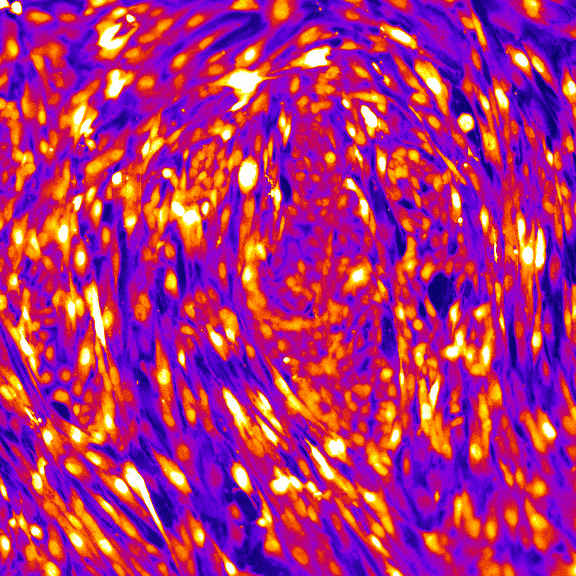
Methods: To characterize and investigate the heterogeneity of oncogenic Ca2+ signatures, we proposed an unbiased scalable method that combines single cell calcium imaging with graph-based unsupervised and artificial neural networks.
Results: From an initial dataset of 27,439 agonist-induced Ca2+ responses elicited in a panel of 16 prostate and colorectal cancer cell lines, we discriminate 26 clusters of Ca2+ responses using unbiased unsupervised clustering. From these clusters, we generate Ca2+ signatures for each cancer model allowing to functionally compare different cancer models. In parallel, we propose supervised neural network models predicting characteristics of a single cancer cell based on its profile of Ca2+ responses. We applied those methods to characterized a remodeling of Ca2+ signatures associated with acquired docetaxel resistance (12,911 cells) or in the course of the interaction of cancer cells with fibroblasts (34,676 cells). At single cell level, our supervised neural network succeeded to identify docetaxel-resistant cancer cells and to distinguish cancer cells from fibroblasts on the sole measure of agonist-induced Ca2+ response.
Conclusions: Our method demonstrates the potential of Ca2+ profiling for discriminating cancer cells and predict their phenotypic characteristics at single cell level, and provides a framework for researchers to investigate the remodeling of the Ca2+ signature during cancer development.
Keywords: Cancer cells; Colorectal cancer; Docetaxel resistance; Graph-based unsupervised clustering; Predictive neural networks; Prostate cancer; Single cell calcium imaging.